Exhibits
Free exhibits are currently On View at the library and at the Coronado Community Center (C3) Gallery.
Alice: Illustrating Wonderland: Celebrating 160 Years of Alice’s Adventures in Wonderland
One hundred and sixty years ago Alice’s Adventures in Wonderland was published. Written by mathematics professor Charles Lutwidge Dodgson under the pen name Lewis Carroll, the book has never been out of print and has been translated into 174 languages. The first manuscript copy of the book was personally illustrated by Dodgson and given as a Christmas gift to Alice Liddell, the purported real-life inspiration for the character – though scholars disagree as to the extent to which Dodgson based the fictional Alice on Liddell.
In 1907 Alice’s Adventures in Wonderland entered the public domain, and since then, a steady stream of illustrators have braved comparison to John Tenniel, the original illustrator of the published book, by reimagining Wonderland in their own unique styles. The visual landscape of Alice was irrevocably changed after the Walt Disney Company bought the film rights to Alice’s Adventures in Wonderland with John Tenniel’s illustrations in 1938. The bold colors and modernist designs, including Alice’s now-iconic blue dress and white pinafore, were characteristic of the concept drawings submitted by background artist Mary Blair and handpicked by Walt Disney to be the visual framework for the animators of Disney’s Alice in Wonderland (1951).
To celebrate Alice’s 160th birthday, we are exhibiting 160 unique illustrators of this enduring work of children’s literature. The whimsy and fantasy of the tale demands illustration, as does the titular character herself, who muses, “And what is the use of a book…without pictures or conversations?” This exhibition highlights only a fraction of the diversity of cultural and stylistic interpretations of one of the most republished, adapted, and reinterpreted works of literature in the world. We hope you enjoy your trip down the rabbit hole – there is a vision of Alice’s Adventures in Wonderland to satisfy any aesthetic sensibility!
All books on display in this exhibition are on loan to Coronado Public Library, courtesy of an anonymous collector.
Bridging the Bay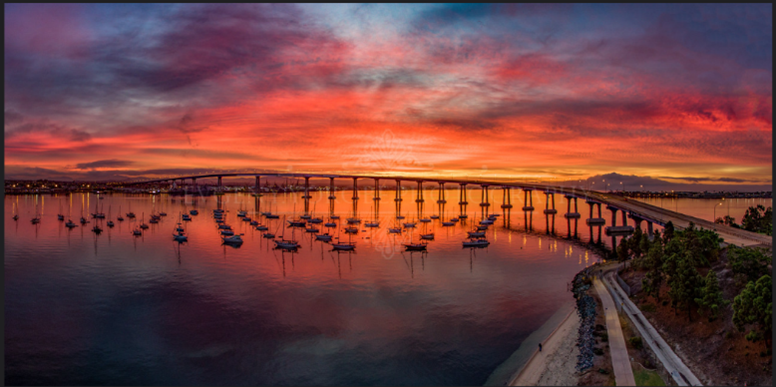
Almost fifty years in the making, the San Diego-Coronado Bay Bridge cuts an iconic, sweeping blue line of steel and concrete across the San Diego Bay. The bold declaration, in September of 1926, by the Spreckels Companies that “definite plans” had been made for “bridging the bay” quickly devolved into decades of waxing and waning political will. Debates among politicians and the public alternated between whether a bridge or an underwater tunnel was the appropriate solution, or whether a vehicular crossing should be built at all, until 1962 when the California Toll Bridge Authority officially recommended a four-lane bridge.
In the end, the Army Corps of Engineers approved a bridge in 1965, and the Toll Bridge Authority authorized revenue bonds totaling $47.6 million to finance it. Initially opposed to the project, the bridge’s principal architect, Robert Mosher, resolved to prioritize an aesthetically pleasing design once its construction became inevitable. Drawing inspiration from the Cabrillo Bridge, which spans State Route 163 into Balboa Park, Mosher proposed a box-girder bridge with an orthotropic deck—a technique that was new to the United States at the time. Construction began in February 1967, and the bridge officially opened to traffic on August 2, 1969. As of 2025, the Coronado Bridge averages nearly 100,000 vehicle crossings daily.
Edith Purer & Our Local Ecology
Edith Abigail Purer, born December 11, 1895, in Illinois, had a remarkable career in both science and the arts. Purer studied at the Art Institute of Chicago and at Northwestern University, where she earned an undergraduate degree in botany. She received a master’s degree in botany from the University of Chicago. For 13 years, Purer taught at Chicago High School before relocating to Los Angeles to obtain her PhD at the University of Southern California in 1933—a rare achievement for a woman of her time.
Purer then moved to San Diego and taught science at Hoover High School for 17 years. During her tenure at Hoover, she collected over 5,000 plant specimens between 1930 and 1940, meticulously preserving and cataloging each specimen for herbariums. Many of these invaluable samples now reside at the San Diego Natural History Museum and the Arnold Arboretum at Harvard University.
Purer's ecological research focused on vernal pools, salt marshes, and coastal sand dunes; she made significant contributions to the understanding of Southern California's ecosystems. She was the first scientist to document the region's salt marshes, conducting thorough surveys of 11 estuaries in San Diego County, and providing detailed insights into species diversity and plant conditions.
In addition to her scientific endeavors, Purer was a prolific author, publishing eight peer-reviewed ecological articles, and the book “Plants of Silver Strand Beach State Park” (1936). Following her retirement from teaching, she had a successful career as a landscape painter, exhibiting her work extensively throughout California and beyond. By 1971, she had sold over 1,100 paintings and garnered recognition from various art associations.
Edith Purer's legacy lives on through her pioneering contributions to science and art. She passed away on June 20, 1990.
Vietnam's Valiant Heroes: A Tribute to Military Nurses
In the tumultuous era of the Vietnam War, a conflict that spanned from 1955 to 1975, courageous military nurses emerged as often-overlooked figures, making a profound impact on the war effort. Frequently working under challenging conditions and bearing witness to the harsh realities of combat, these dedicated women played an integral role in providing compassionate care to the wounded. The Vietnam War, a complex and divisive conflict, marked a significant chapter in history, leaving a permanent imprint on the collective memory of the nation.
Amidst the chaos of war, military nurses became beacons of hope and healing, offering solace to those in pain and distress. This exhibit "Vietnam's Valiant Heroes: A Tribute to Military Nurses" highlights their unwavering commitment to their patients and the sacrifices they made. Through a compelling collection of photographs and personal narratives, this exhibition sheds light on the incredible stories of resilient women who faced the challenges of war with courage and compassion. As we reflect on the sacrifices made during the Vietnam War, let us remember and honor these often-overlooked heroes who, through their compassion and dedication, played a crucial role in the healing process amid the turmoil of war.
This exhibit provides a unique snapshot of the Vietnam War through the eyes of the nurses. The photographs, quotes, and interviews are sourced from various Veterans' collections from esteemed institutions such as the Library of Congress, Texas Tech University, and the University of North Carolina Greensboro, along with contributions from various books available in our library.
We extend our heartfelt gratitude to the following nurses, who dedicated their time to serving in Vietnam and contributed to this exhibit by writing books, participating in interviews, and donating their photographs to tell their story:
RADM Frances Shea Buckley, retired Navy Nurse Corps, operating room supervisor on the USS Repose, 1968.
-1LT Patricia Anne Ehline, retired Army Nurses Corps, surgical and emergency nurse at the 2nd Surgical Hospital in Chu Lai, 1968-1969.
-1LT Patricia Bryant, retired Army Nurses Corps, nurse at 67th and 85th Evacuation Hospitals in Qui Nhon, 1967-1968.
-LTC Aida Nancy Sanchez, retired Army, physical therapist/nurse at 95th Evacuation Hospital in Da Nang, 1970- 1971.
-CAPT Rae Mary Leff, retired Navy Nurses Corps, nurse on the USS Repose, 1966-1967
-1LT Anne N. Philiben, retired Army Nurse Corps, intensive care nurse at 36th Evacuation Hospital in Vung Tauk, 1967-1968.
-CAPT Helen Brooks, retired Navy Nurse Corps, Chief Nurse at the Fleet Support Activity facility in Da Nang, 1968-1969.
-LCDR Helen Roller, retired Navy Nurse Corps, nurse in Station Hospital Saigon and USS Repose, 1965-1966.
-LCDR Bobbi Hovis, retired Navy Nurse Corps, intensive care nurse at Station Hospital in Saigon, 1963-1964.
-CDR Mary F. Cannon, retired Navy Nurse Corps, nurse at Station Hospital in Saigon, 1967-1968.
-LTC BJ Kramer, retired Army Nurse Corps, nurse at 312th Evacuation Hospital in Chu Lai, 1968-1969.
-LTC Diane Kay Corcoran, retired Army Nurse Corps, operating room nurse at 24th Evacuation Hospital in Long Binh, 1969-1970.
-2LT Barabara Greenway Rasmussen, retired Army Nurse Corps, burn and trauma nurse at 93rd Evacuation Hospital in Long Binh, 1968.
Memories in Miniatures by Joan and Bill Helton
A love for antiques and a passion for collecting brought Joan and Bill Helton together in the 1960s. They met while working in the antique business in San Diego. In the 1970s they closed their Adams Avenue antique shop to dedicate their time to their hobbies, but a twist of fate forced them to rebuild their fire-damaged Victorian home. This experience gave them the necessary construction and woodworking skills they would later use as miniature craftsmen.
Bill’s interests included toys, stamps, coins, postcards, and political memorabilia. Joan collected dolls, buttons, apothecary jars, and vintage sewing items. Joan was a longtime member of the San Diego Doll Club. With a collection of some five hundred dolls, she eventually turned her skills toward doll house furniture and accessories. Along with several other Doll Club members, she helped form the local chapter of The National Association of Miniature Enthusiasts (N.A.M.E.) Joan was the visionary and decorator, while Bill was the builder, cabinetmaker, and electrician. Bill’s interest in Western and Native American artifacts inspired several displays, and their proximity to San Diego’s Old Town led to many historical depictions.
In 1977, they built a version of the La Casa de Estudillo in Old Town for the N.A.M.E National Convention in San Diego. It was presented as the raffle prize and was eventually shipped to San Antonio, Texas. That was the first of many commissioned projects they accepted including Gump’s in San Francisco and a two-story replica of Tiffany’s in New York. Over the next 20 years, Joan and Bill were prominent members of the California miniature scene, first as collectors/hobbyists, then as well-respected craftsmen. They created over 70 shops/displays and as their business expanded, they had a repertoire of over 250 miniature items for sale at shows and conventions until the 1990s.
Upon retiring a second time, Joan turned her collecting enthusiasm to vintage buttons, which she collected until her death in 2015. Bill has continued pursuing his interests in buttons, political memorabilia, and Asian art. He has maintained his membership with the San Diego Button Club and still attends their meetings at the ag
Bobs, Beads, and Flappers: Women's Fashion in the 1920s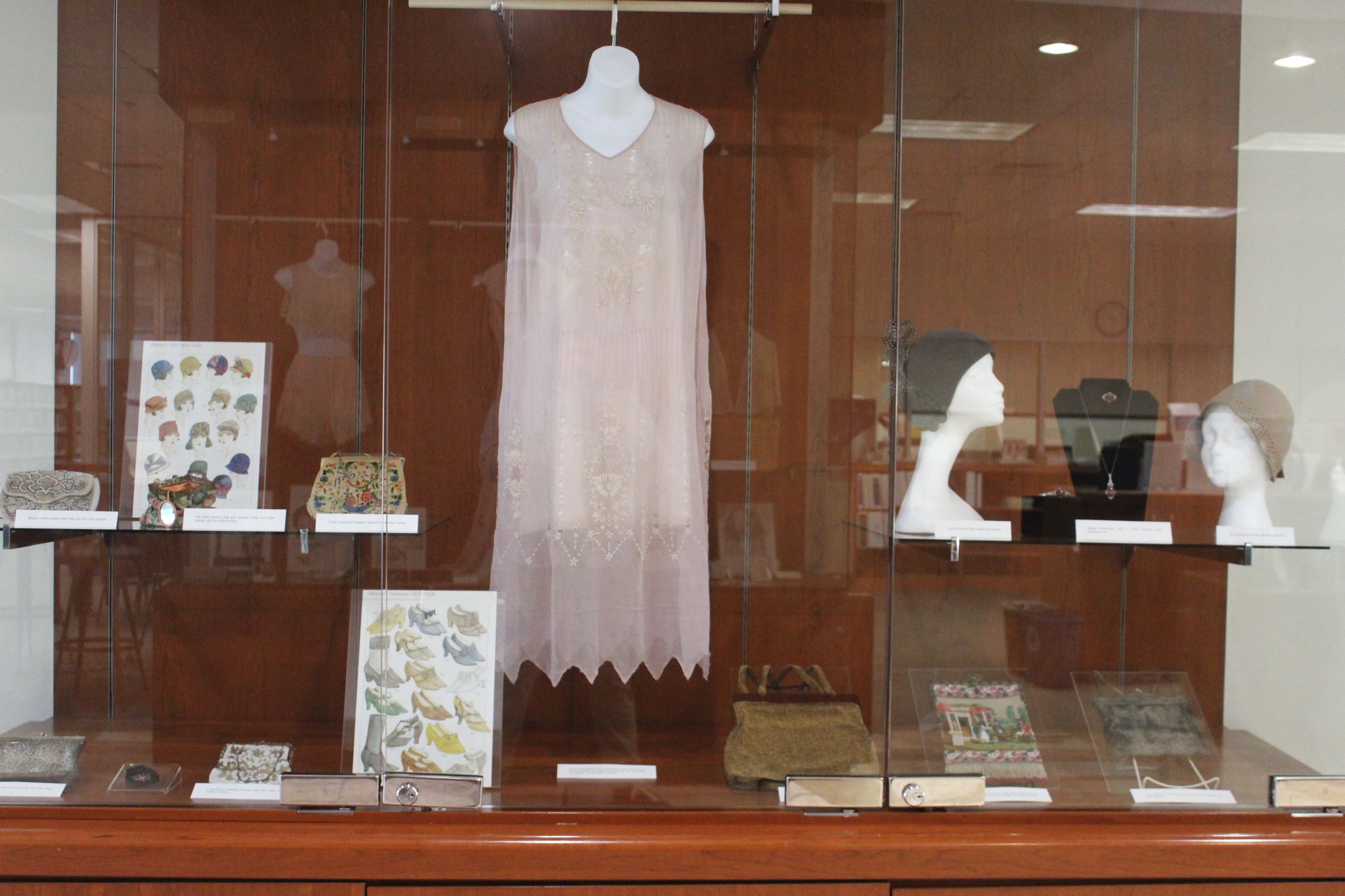
One hundred years ago the fashions and lifestyle of the “flappers” were in full swing. The death of millions of young men in World War I caused many youths to believe that life was short and fun should be had while one still could. The arrival of jazz, fast cars, and money happened when many young women moved to the city and started working. The movies became popular, and women got their fashion cues from the stars of the day: Gloria Swanson, Colleen Moore, Joan Crawford, Greta Garbo, and others.
World events also influenced fashion and jewelry styles. The Exposition des Arts Decoratif in Paris in 1925 launched the popularity of Art Deco in architecture, furniture, jewelry, and dress ornamentation. King Tutankhamun’s tomb and treasures were found two years earlier in Egypt in 1923. The styles of these Egyptian objects became very popular (as did movies about classical Egypt). The color of “Eau de Nil” (water of the Nile) green became a popular color for dresses and gowns of the mid-1920s – to reappear on the dresses of Grace Kelly and Tippi Hedren in costumes by Edith Head in the 1950s and 60s.
The items on exhibit provide a window into the tastes of the young women of the Jazz Age and the new consumer items available to them. While corsets are still present in advertisements, this period and the few years before was the first time women were not tightly bound by their undergarments. The bra as shown was typical of those in the 1920s, where the flat-chested look was desired along with the drop-waisted dress. By contrast, the flapper skirt was short, worn for daytime or informally.
Make-up and lipstick had become popular for the young woman – a novelty. The vanity cases became an item of necessity as well as something to show off. The big hats of the 1910s became tight-fitting cloche hats, skull caps, or even just scarves tied around the head. Long ropes of pearls and bead necklaces were another signature.
The Spirit of Spring Exhibit by the San Diego Watercolor Society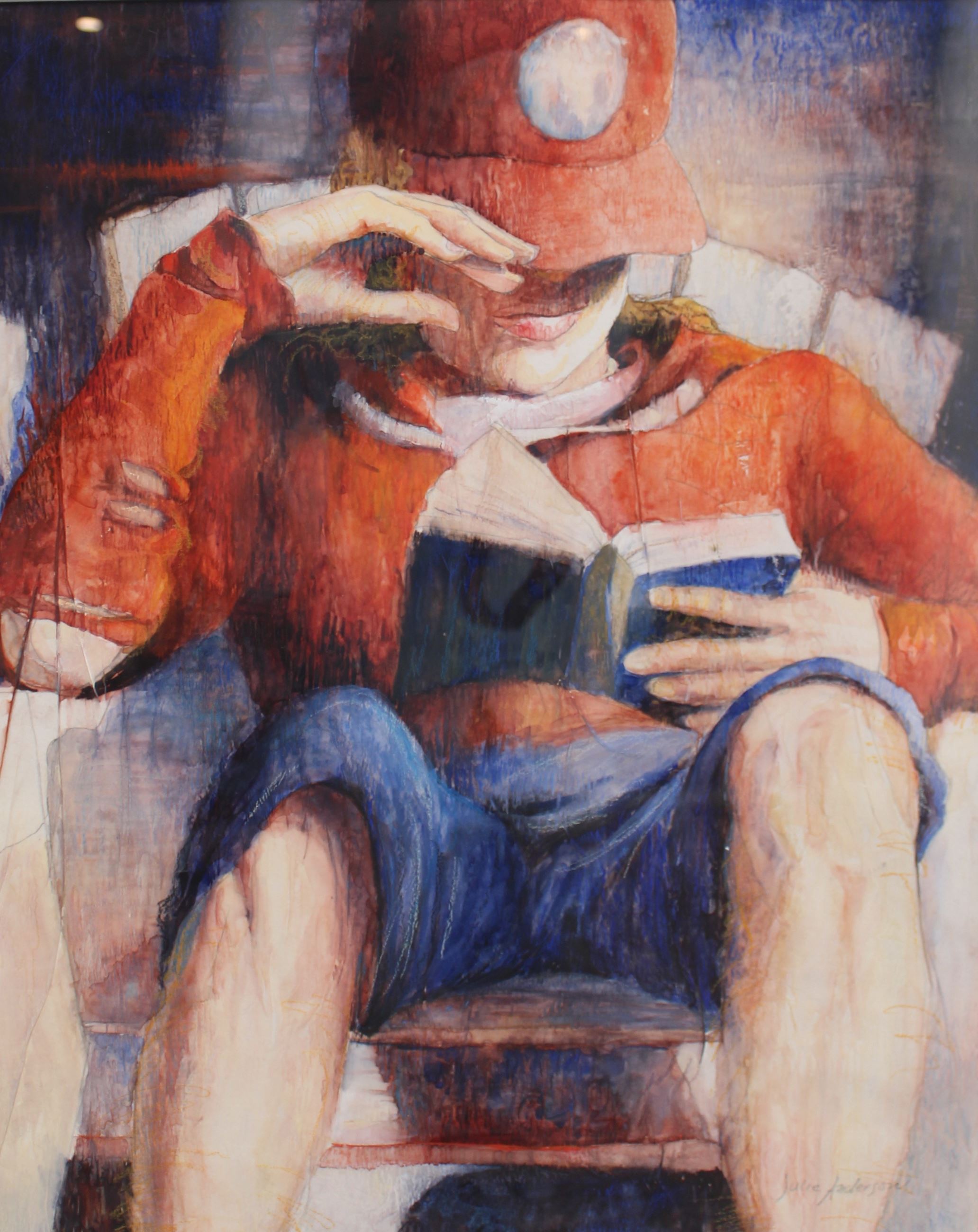
As His Eyes Saw It
Photos by Major Morris, educator and photographer from the US northeast in the 1960s
During his long life of 95 years, Major Morris was a photographer, a World War II veteran, a college professor, a Harvard University graduate and a champion of education.
Major Morris grew up in Cincinnati's poverty-stricken West End during the Great Depression. He dropped out of high school at 15 to help support his family after his grandmother’s death. Morris served in the Po Valley of Northern Italy in the segregated US Army during WWII. After the war he worked several menial positions while trying to continue to educate himself at night school, among others at MIT. He was accepted to Harvard University at the age of 55 and got his master’s degree in 1976. During his working life and time at Harvard he supplemented his income as a freelance photographer. Morris went on to become a college administrator and professor teaching education and was a lifelong champion of nurturing children’s dreams of a better future regardless of their circumstances. Major Morris died in 2016.
World War II: Portraits of Honor
Photos by Jeffery Rease
Coronado's Tom Rice is one of the veterans featured in the 'World War II Portraits of Honor' project, a celebration of the Greatest Generation which aims to capture the images and stories of veterans of the second world war.